
Tried and tested: Five lessons for community-led funding programmes
With the Big Local programme now closed and new neighbourhood initiatives underway, our head of programmes, Meg Falck, shares five valuable lessons for the future of community-led funding.
When Big Local launched in 2011, nothing of its scale or ethos had existed: 150 communities, £1m each and the freedom for residents to decide what mattered most. Fifteen years later, community power has moved much closer to the mainstream. As Local Trust approaches closure, one question I get asked again and again is: what would we do differently? There isn’t a simple answer, but these are five lessons I’d carry into any future community-led funding programme.
1. Buildings need long-term support
Although physical assets and buildings were never an explicit aim, community buildings became one of Big Local’s biggest legacies. More than £28m was invested in over 200 buildings and spaces, with 40 resident-led organisations continuing to run community hubs today.
What we underestimated was how much support these projects require. Community Assets Transfers, planning, governance, fundraising and business planning often took years, and areas with buildings needed significantly more technical support than others. Those that invested in assets early on benefitted from 10 years of ‘incubation’ support – in other areas, it took nearly 10 years for asset acquisition alone.
Overall, we spent 30 per cent more on support to Big Local areas that had an asset project than those that didn’t, often from national providers, depending on the context and quality of local providers.
The lesson isn’t ‘don’t invest in buildings’. It’s to invest just as much in the people, partnerships and support networks that make those buildings sustainable, as I argued during a recent funder roundtable with IVAR. And if I could turn back the clock, I would put more emphasis on linking community-run buildings into their local support and infrastructure networks sooner, to ensure the best chance of sustainability beyond Local Trust’s lifetime.
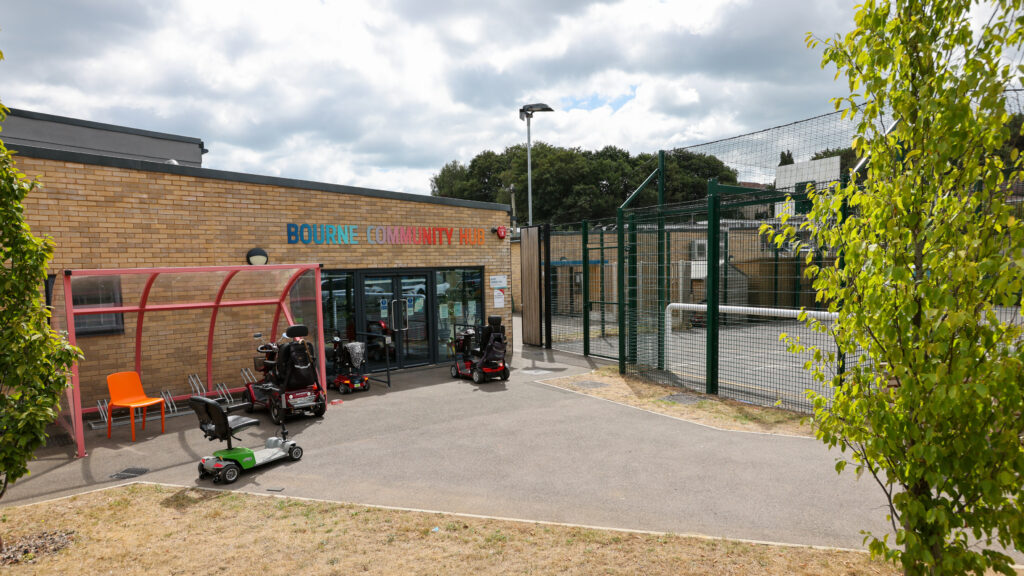
Bourne Community Hub acquired by Bourne Big Local, Poole, Dorset. Photo: Local Trust/Richard Crease
2. Invest in community development workers as well residents
Also not in the original design of Big Local, the role of paid workers quickly emerged and proved crucial across the programme. Two hundred sixty-five paid workers were employed on behalf of Big Local partnerships by 2021.
Having skilled staff (usually community development workers or community engagement specialists) helped to deliver activities, drive projects forward, support partnership governance and resident decision-making. Workers often took pressure off partnership members who were volunteers, but the worker role could also be isolating, sometimes caught between their employer (the Locally Trusted Organisation who administered the funds) and the partnership (the decision-makers setting the direction of their work).
Throughout the programme, Local Trust acted both as funder and support provider, but support was primarily focused on residents – through coaching, capacity building and leadership development – rather than workers, in line with our resident-led ethos.
Over time, it became clear that the wider community development infrastructure could not consistently provide the specialist support needed by either residents or the people supporting them locally. As the programme matured, gaps in leadership development, professional learning, peer support and practical guidance for community development practitioners became increasingly apparent.
By ensuring residents were in the lead and focusing support mostly to residents, we missed opportunities earlier on to do more strategic work with a whole workforce employed through the programme. In 2022, we launched a worker development programme to address this.
“The BL programme would not have got anywhere without the workers. They are in the downstream flow of stress where statutory services are underinvested, as is the third sector and grassroots sector. People like us, the workers, are dealing with front line issues. The growth and support of workers is key if there are future programmes.” – Big Local worker and participant of the the worker development programme.
3. Make inclusion a core programme requirement
Big Local’s resident-led model was intentionally non-prescriptive: partnerships were expected to reflect and involve the whole community, but they were not designed as representative democracies. That freedom was central to the programme’s ethos, yet it also meant that expectations around equality, diversity and inclusion were loosely defined.
The ambition was real: to reach people who had never been involved in formal community structures and to shift power in places that had long been under-resourced. Evidence from the programme shows this worked: Twenty-five per cent of residents involved in Big Local had never volunteered or taken part in community activity before, and 58 per cent went on to other community positions.
But inclusion and representation were uneven, and a 2021 review by brap highlighted a need for more practical support and guidance for Big Local partnerships to have confidence to move from good intentions to consistent practice. Place-based action can help address racism and discrimination when it builds trust, creates safe spaces for dialogue, and shares decision-making power with people most affected. But without explicit design choices and support, activity can result in only small, temporary or incremental gains.
Good intentions aren’t enough. Inclusion matters and future programmes need clearer expectations, practical support and a willingness to proactively challenge exclusion from the outset.
Flexibility is an important part of programme design, and for me is where the richest learning lies.”
4. Plan for legacy from day one
As an experimental programme with a new approach to community development, it was difficult to predict the impact, stories and lasting change that would emerge across the 150 Big Local communities.
By 2019, with local priorities established and delivery in full swing, we introduced guidance to help Big Local areas think about what they wanted to leave behind beyond the life of the programme. For some, there was a sense that physical legacy, such as buildings, community spaces, artworks or murals, was most important. For others, the legacy was as much in the skills, confidence and leadership developed among local people.
Looking back, identifying these ambitions earlier could have helped areas make better use of the support available. We now know that creating physical assets or establishing organisations often requires significant planning, specialist advice and long lead-in times. Earlier consideration of these longer-term goals would have given areas more opportunity to access technical support and links to local infrastructure organisations.
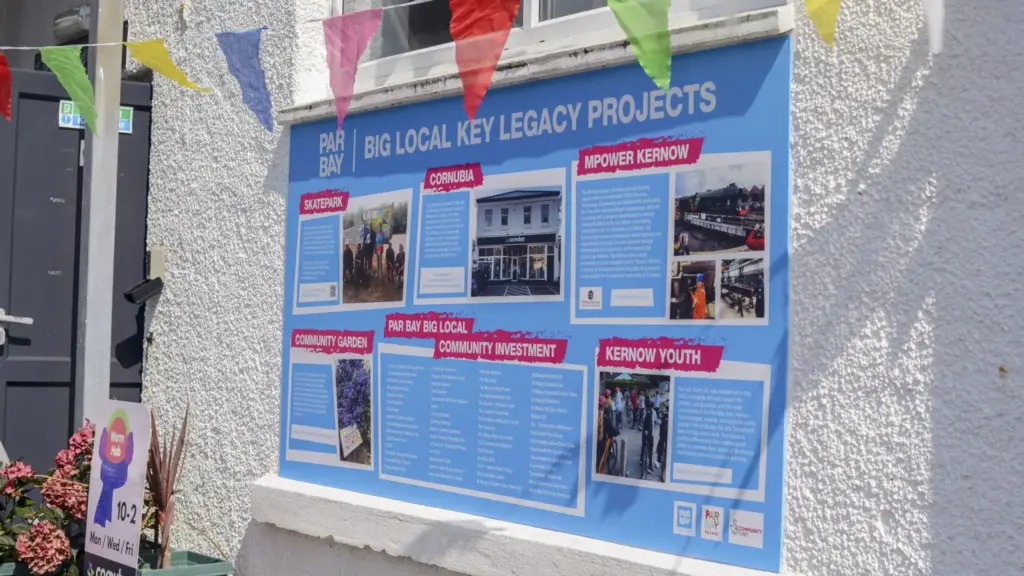
A board displaying the legacy projects of Par Bay Big Local. Photo: Local Trust/Charlotte Sams
5. Design programmes with flexibility
For me, some of the most interesting learning has been from the areas where the Big Local model didn’t ‘work’. In the end, there were seven areas that moved away from the core model of a partnership of residents as the decision-makers. I worked closely with each of these areas to identify alternative ways to spend remaining grant funds, aligning as closely as possible to the resident-led ethos of the programme.
In some of these, the decision to change approach was a practical programme management consideration – for example, in areas that experienced high levels of conflict later on, where there wasn’t sufficient time for deep community work and support to address and overcome this locally before the programme end date. In others, I believe that the Big Local model was always going to struggle, as a result of deep-rooted community tensions and inequalities that £1m only exacerbated. The details behind each is incredibly nuanced and context-specific – as we explore in this article on Learning from Big Local – but proved that flexibility is an important part of programme design, and for me is where the richest learning lies.
Looking ahead
Big Local was never intended to provide a blueprint that could simply be copied elsewhere. Every place is different. But after fifteen years, we know much more about what helps community-led programmes succeed – and where they need to adapt.
As new initiatives such as Pride in Place and the Community Wealth Fund develop, these lessons provide a starting point for designing programmes that genuinely shift power to communities for the long term.
Explore our learning programmes and events to find more insights from the Big Local programme.
Meg is Local Trust’s head of programme and has the overall responsibility of our funding to Big Local areas.