
Are we being ambitious enough with community-led change?
How do you condense a 15-year story of 150 areas and 4,900 volunteers into one learning series? It’s a big question, particularly when the experience of Big Local was so different from place to place.
In February, we launched a series of regional learning programmes: learning events held across London, the East and West Midlands, Yorkshire & Humber, the North East and the Northwest. Having closed the Big Local programme in March, we wanted to share important learning from 15 years of Big Local with funders and selected VCSE organisations, exploring how it might influence their own practice through the voices of Big Local volunteers, support partners and Local Trust staff.
With the funding and VCSE sectors increasingly thinking about long-term, resident-led and hyper-local approaches, it felt like a timely moment to share this learning. We can see this through:
- The National Lottery Community Fund’s 2023-2030 strategy, which puts participation and community-led funding at the core of its approach;
- Esmee Fairbairn’s shift towards longer-term, unrestricted funding;
- and the government’s £5bn investment in communities through the Pride in Place Programme.
The drive of volunteers to make a difference in their area is the bedrock of Big Local.”
One programme, 150 different stories of community-led change
There is so much to tell. With nearly 150 hours of learning and resident voices and experiences at the centre of the sessions, we have tried to do Big Local justice.
But condensing 15 years of experience into a series of sessions is difficult. That is because there isn’t one story or one perspective of the programme, and there is rarely one single way forward when working with communities.
This has led to rich discussions about the key principles behind Big Local, including some of the assumptions we can make about communities and what resident-led programmes should look like.
What happens when power really shifts?
We have talked openly about the unequal balance of power between funders, organisations and communities, and the challenges that can arise when residents are genuinely given the opportunity to lead.
The journey of Big Local Welsh House Farm is one example. It was not about finding a single successor organisation to take things forward. Instead, residents chose to establish three separate Community Interest Companies (CICs), each with its own identity, priorities and ambitions.
This reflected the diversity of interests within the community, but also brought new challenges as residents took on greater responsibility and control. Their experience highlighted the value of a ‘grant plus’ approach, combining financial investment with practical support, advice, facilitation and relationship-building.
Crucially, residents remained in the driving seat. The ‘plus’ was not about a funder taking over or deciding what should happen. It was about creating the conditions and providing the support that enabled residents to make their own decisions and respond to the challenges that came with greater responsibility.
Sharing power is therefore not just about changing who makes the final decision. It is also thinking about what communities need to participate meaningfully and shape what happens in their area.
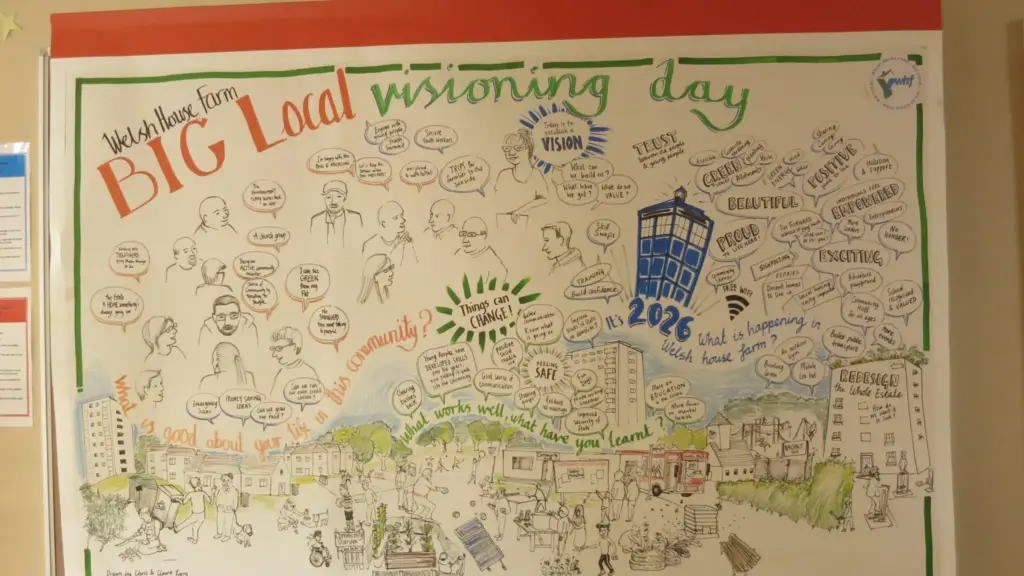
The vision for Welsh House Farm Big Local partnership. Photo: Local Trust
Same principles, different places
One challenge in this learning series has been explaining how Big Local worked without descending into jargon or fiddly explanations. Delivering workshops through cohorts over multiple sessions has helped us build on learning, while giving participants plenty of opportunity to ask questions and explore ideas.
It is also why we have taken a regional approach. Smaller, dedicated groups have allowed us to go deeper into the topic, meet in person where possible and tailor conversations to local contexts.
We have run different cohorts for the East and West Midlands, for example, because conversations can differ between rural and urban communities. This includes differences in:
- relationships
- resources
- infrastructure
- opportunities available to residents.
Facing challenges and difficult conversations
We have not been afraid to confront the challenges in the programme. Big Local was an experimental programme, and experiments do not always work. Things go wrong and different avenues are pursued.
There have been difficult conversations, but we have valued the honesty with which Big Local volunteers and support partners have spoken about their experiences, challenges and what they learned from them. These have often felt like the richest moments of reflection.
Resident-led funding is incredibly personal. For residents, the emotional investment in the programme can be huge. The resilience shown through difficult times, and the determination to keep going because they wanted to see change in their community, is remarkable.
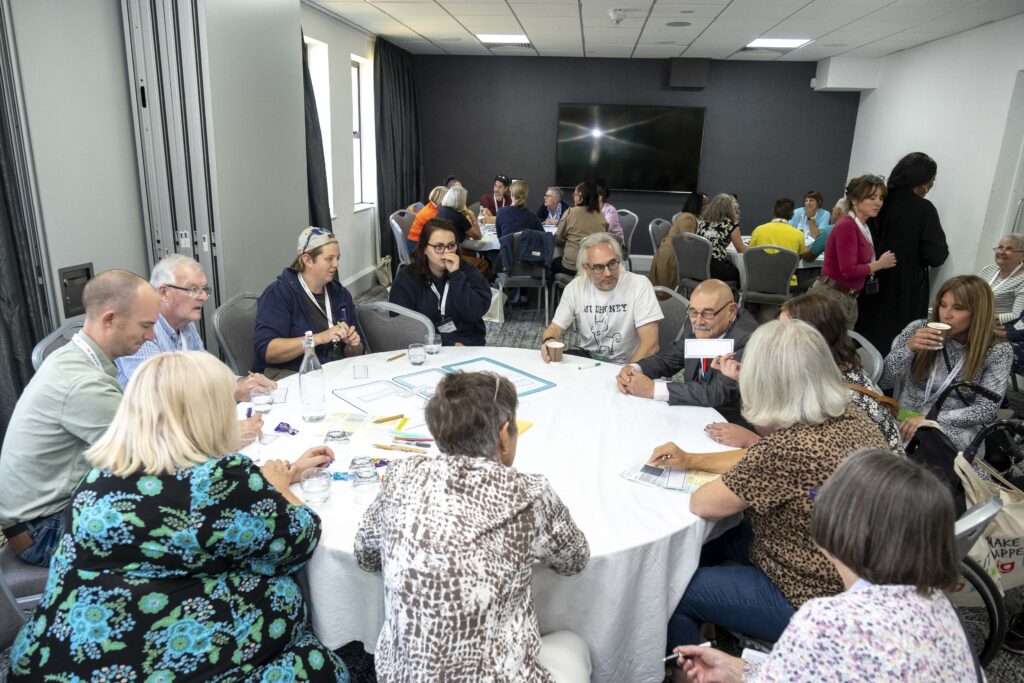
Group discussion taking place in one of the sessions at a Big Local event. Photo: Local Trust/Richard Richards
What are we prepared to trust communities with?
The drive of volunteers to make a difference in their area is the bedrock of Big Local, and this came as a surprise to some of the funders in the room.
At Local Trust, we know that when residents are trusted with funding and resources, they can come together and develop their own solutions. With a deeper understanding of their communities and local priorities, residents may take things in a direction that organisations or funders had not anticipated.
Perhaps, then, the role of funders and organisations is not to have all the answers, but to create the conditions in which communities can develop their own solutions and have genuine influence over decisions that affect them.
There is a perception that giving unrestricted funding to residents is a risk. But perhaps we should be asking a different question: are we being ambitious enough about what communities can achieve when we trust them with the resources and power to lead?
Sometimes reflection is the learning
The learning events have also created something unexpected: a powerful opportunity to reflect.
For the volunteers and support partners who have contributed, having the space to look back on their Big Local journey has been incredibly rewarding. Whether they have been involved from the start or only for the last few years, opportunities to stop and reflect can be rare.
For Local Trust colleagues, the questions from people who do not necessarily know the programme well have also helped us see Big Local differently and revisit parts of the programme we may have taken for granted.
Our regional learning programmes are still ongoing. We’ll be running further learning sessions from September to November 2026, providing more opportunities to explore the learning from Big Local and consider how we work with and support communities going forward.
If you’re a funder or VCSE organisation interested in community power, resident-led approaches and learning from Big Local, I’d encourage you to join us.
Ezra and Maxine are both senior programme coordinators at Local Trust.