
Building neighbourhood health from the heart of six communities
Across the country, community-led organisations are helping people stay well, feel connected and access support long before they reach a GP surgery or hospital. But what happens when these neighbourhood organisations are recognised as partners in improving health, rather than simply providers of services?
Over the past year, we’ve been working with six former Big Local areas to explore what it takes to build approaches to neighbourhood health that are truly community-led.
Through an action research programme delivered in partnership with the NHS Alliance and the Innovation Unit, community-led organisations have been testing how hyper-local approaches can deliver health outcomes and strengthen relationships with local statutory services.
We are seeking to find out…
- How can community-led organisations work together with statutory partners to understand a community’s health and care needs at a hyper-local level?
- What are the principles, behaviours and approaches needed to work together successfully?
- What are the conditions within places and within structures/systems that enable closer place-based working?
As the programme moves into its final phase, we’re starting to see some clear patterns emerge. If you’re interested in how this could work in your community, we’re sharing what we’ve learned so far.
While every place is different, the work has highlighted a shared set of principles and conditions that help community-led and statutory partners work together more effectively.
When communities are trusted, resourced and given the space to lead, they bring insights, relationships and solutions that statutory services cannot achieve alone.”
Six communities, six different approaches
The six sites are all different and that’s exactly the point. The VCSE sector’s strength lies in its diversity. Organisations are rooted in different places, respond to different challenges and build on different community assets. Any approach to neighbourhood health needs to recognise and work with that diversity, rather than trying to create a single model.
- In West End Morecambe, Lancaster CVS has been exploring isolation through deep hyper-local engagement and community data analysis.
- In Podsmead, Gloucester, Blackbridge Charitable Community Benefit Society has been building trust with residents and using local insight alongside NHS and housing data to improve community spaces.
- Par Bay Community Trust in Cornwall has focused on rural isolation and transport barriers, exploring how residents can better access health activities and services with a community-led transport service.
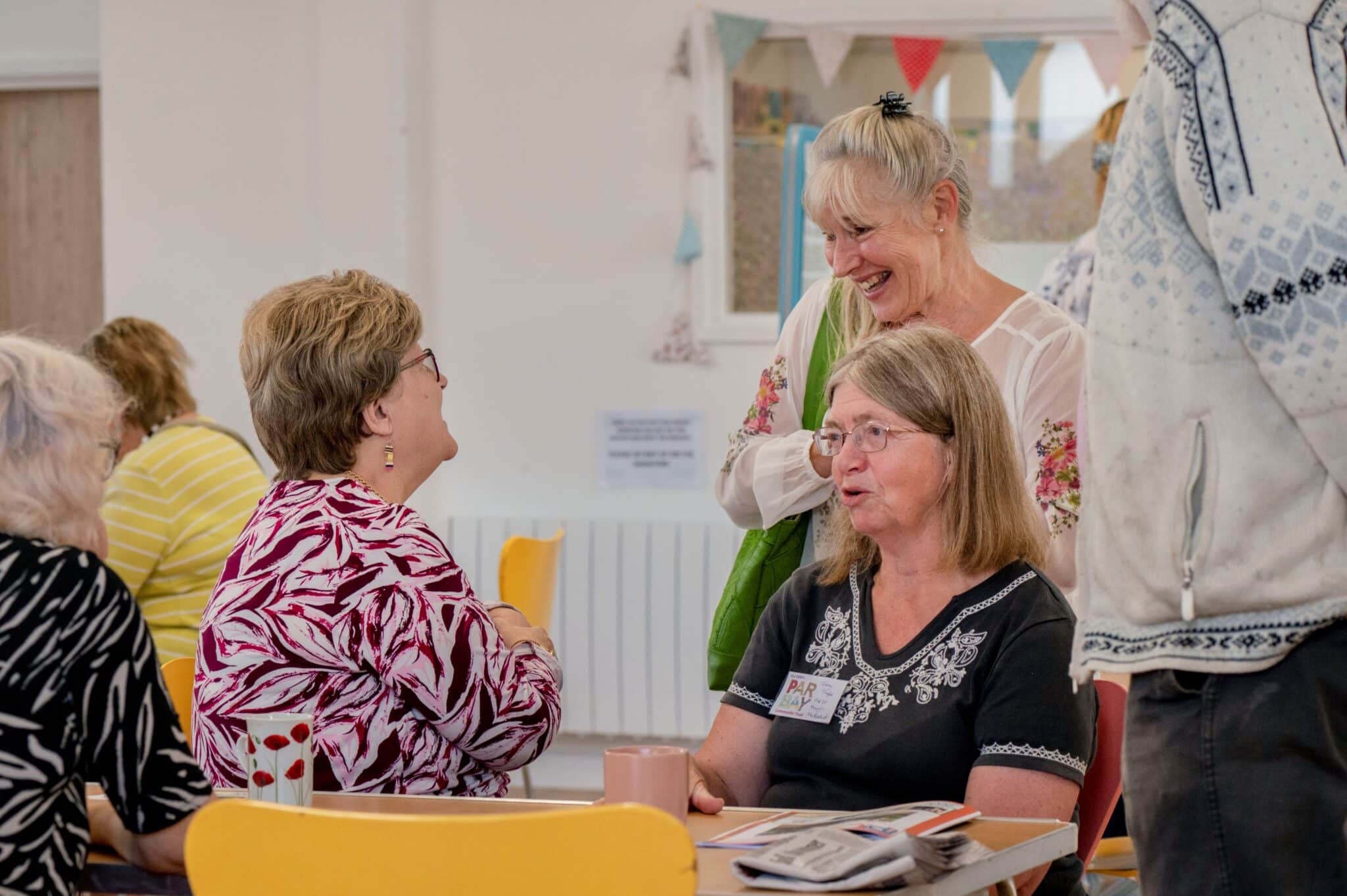
A group of women chatting at Cornubia community hall. Par Bay celebration event. Photo: Charlotte Sams
- Vysions in Brereton in Staffordshire has been mapping local need and support offers to strengthen coordination between residents and providers.
- In South London, the Battersea Alliance has been exploring how community prescribing can better connect residents with local support, while also strengthening relationships between community-led organisations and statutory partners. The partnership has built momentum around a wider vision for neighbourhood health, including the launch of the new Kambala Creative Health and Wellbeing Hub, a community-led space designed to support connection, wellbeing and collaboration across the neighbourhood.
- The Centre in West Cumbria has been creating safe and honest conversations to understand barriers residents face when accessing support.
The action research has reinforced that there is no one-size-fits-all model for neighbourhood health. Effective approaches are shaped by the assets, relationships, challenges and histories of individual places.
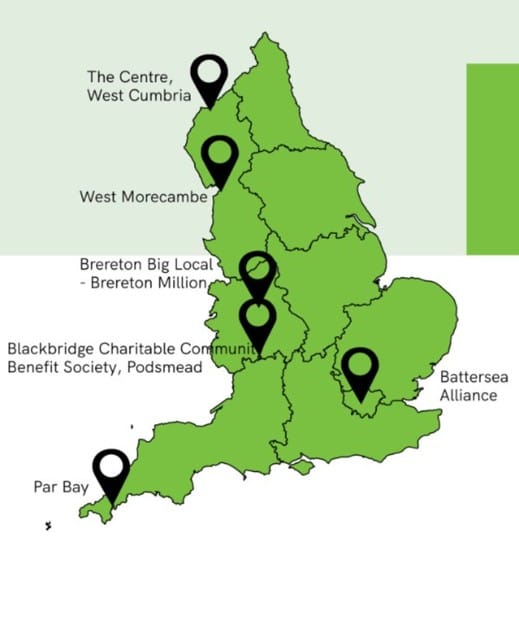
A map showing the six communities taking part in the health action research.
What we’re learning about conditions needed for neighbourhood health
Longer-term investment – in relationships and funding. It takes time to build trust, establish productive working relationships and come together around complex issues. If partners are freed from the burden of immediately seeking more funding, they can invest more capacity in these shared challenges.
Collaboration over competition – pooling resources across the VCSE sector to maximise impact, using a trusted intermediary such as an alliance or CVS to steward shared goals, culture and values.
Co-location – statutory partners located in community spaces builds understanding, strengthens legitimacy and allows for the identification of collaboration opportunities.
Managed uncertainty – embracing the ‘messiness’ of community-led working, with a common-sense attitude towards risk.
Ownership and accountability – sites felt that progress was made when partners had the power and permission to make commitments and drive the work forward.
Outcomes over activity – tying funding to intended outcomes, rather than delivering specific activities, allows partners to test and learn to see what works for their community, rather than having to implement a predefined plan.
Strengths-based approach – applied not only to the communities and local residents, but also to the partnerships themselves, focusing on what each partner does best.
Building momentum – around a concrete and tangible focus where community partners already have the skills, knowledge and understanding to move forward quickly.
Building with communities, not delivering to them
One of the clearest lessons from the programme so far is that neighbourhood health isn’t something that can be delivered to communities. It is something that is built with them.
The six sites have shown that when communities are trusted, resourced and given the space to lead, they bring insights, relationships and solutions that statutory services cannot achieve alone.
As the programme enters its final phase, we will continue to learn alongside these communities and to share what their experiences can teach us about creating healthier neighbourhoods across the country.
These insights are based on interim learning from the action research programme delivered by Innovation Unit in partnership with Local Trust and the NHS Alliance. Find out more here.
Ruby Frankland is Local Trust’s strategic partnerships manager.