
What does ‘neighbourhood working’ look like in practice?
Reflecting on discussions at this year’s LGA Conference, our policy and communications assistant, Oluwatosin Adekanmbi, explores how investing in trust, relationships and community capacity are essential to building stronger neighbourhoods and delivering community-led change.
As a first-time attendee of the recent LGA conference, I found it insightful. Alongside new acronyms and local government terms I heard for the first time – like corporate parent, NEET and EFS – it was encouraging to see so many community-led organisations sharing their experiences, evidence and practical ideas from up and down the country.
The conference this year centred around neighbourhood working. Over three days and across the many sessions I attended, speakers emphasised the need to work at a neighbourhood level, build trust and relationships, and place communities at the heart of decision-making. While this may be expected at a local government conference, the more pertinent question is how? How do we build trust, sustain relationships, and create the conditions for community-led change?
At Local Trust, we have championed these conversations for more than fifteen years. Working with residents across 150 neighbourhoods, we have seen that the strongest communities are built when residents are given the power and resources to shape the changes that matter most to them.
With the steady increase in neighbourhood working initiatives, including neighbourhood health, these discussions couldn’t have come at a better time.
Empowering communities requires investment in people, not just places.”
Leveraging social capital to deliver with communities, not for them
One of the key messages at the conference was that neighbourhood working is evolving. Success is no longer measured by activities or how well services are delivered for communities, but by how effectively we work with communities. Too often, programmes are designed around what institutions think communities need; but community-led change starts from a different place – listening to residents, understanding local priorities and recognising that the people who experience a challenge are in the best position to shape its solution.
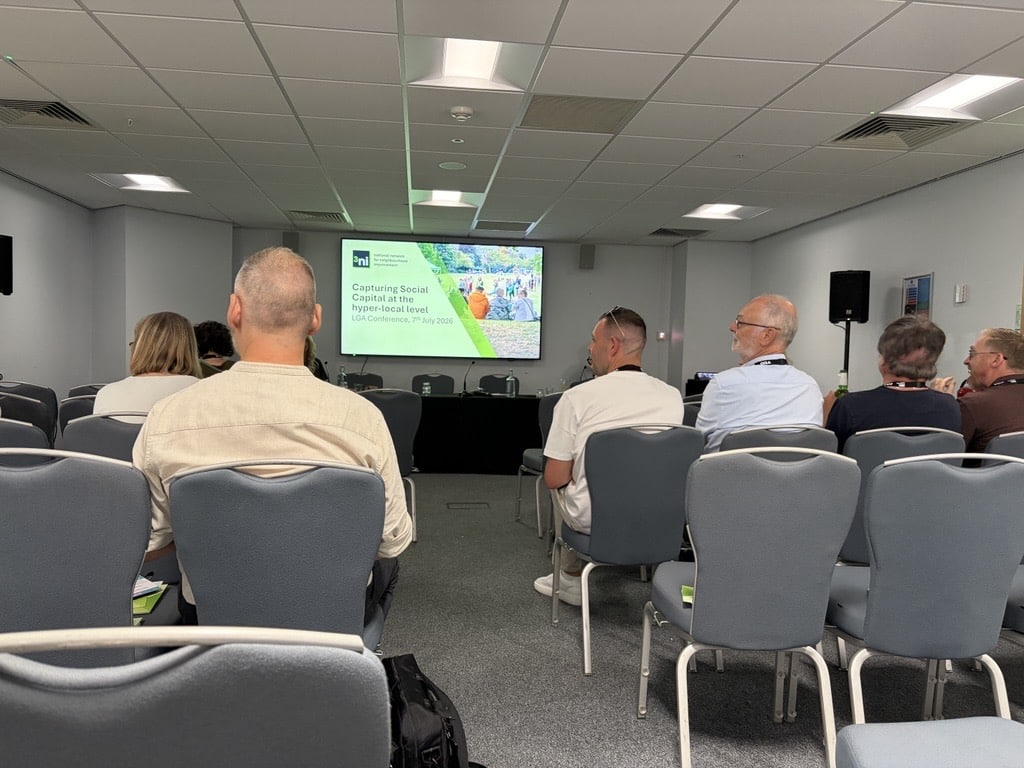
Attendees at the 3ni session on social capital at the LGA conference. Photo: Local Trust
A session delivered by 3ni (the National Network of Neighbourhood Improvement) explored the role of social capital in enabling community-led change. 3ni serves as a learning network specifically tailored for local government officers, public sector agencies, and policymakers, and builds on the learning from community-led work of the Big Local programme. Speakers emphasised that empowering communities requires investment in people, not just places.
To identify where this is most needed, 3ni has developed a Social Capital Score that measures community capacity and social capital across England. Rather than simply highlighting deprivation, the tool seeks to identify place-based inequalities and reveal where communities may benefit from greater investment in relationships, networks and capacity building. Representatives from Wigan Council shared how the data has informed the area’s planning for the Pride in Place funding, helping them identify priorities and shape decisions about how investment should be targeted.
However, data alone will not create stronger neighbourhoods. It should be used transparently and collaboratively to help residents identify priorities and shape investments. Data should also not become another deficit measure that labels communities by what they lack. Instead, it should be framed in a way that identifies opportunities and informs future investments.
At worst, neighbourhood working looks like co-production, at best, it is change led by the community itself.”
Neighbourhood health starts long before we need the NHS
This same principle applies to neighbourhood health. The NHS’s ambition to deliver neighbourhood health is about bringing services closer to people, helping them to live well in their local communities and reducing reliance on statutory health services, by shifting resources towards prevention and community-based healthcare. To deliver this vision, the way health services and professionals work with communities must be redesigned.
Clinical care only accounts for about 10 to 20 per cent of health outcomes. The remaining 80 to 90 per cent are determined by social factors, such as income and education, and the everyday conditions of where people live, grow, and work.
This means that neighbourhood health cannot start only when someone needs a healthcare service. Neighbourhood health begins in the places where people already live their lives – community centres, parks, cafés, pubs, and schools. It grows through the relationships, networks and trusted organisations that help people stay well, reduce loneliness, and avoid crisis before formal services are needed.
Speakers advised that successful delivery of neighbourhood health should be anchored to four pillars:
- Trust: Communities need the space and power to lead, rather than having solutions designed for them.
- Relationships: Cohesive communities are built through long-term investment in people and relationships, not just programmes. These relationships are often what prevent problems from escalating into crises.
- Capacity-building: There must be sustained investment in people’s skills, confidence and leadership so that communities have the capacity to deliver the change they want to see.
- Community assets: Too often, public services begin by identifying what is wrong with a place. An asset-based approach instead starts with what is strong: local groups, informal networks, trusted community organisations and the skills and knowledge that already exist within neighbourhoods.
These principles reflect what we’ve learned through 15 years of Big Local. The programme has shown that investing in people and communities can improve health and wellbeing long before someone needs formal health services.
In Bradley Big Local, residents identified health and wellbeing as a local priority and invested in a community garden, fitness sessions and free sport activities for young people. Beyond improving physical wellbeing, residents benefitted from the relationships, social connections and a sense of belonging that these activities created, strengthening the community’s capacity to support one another.
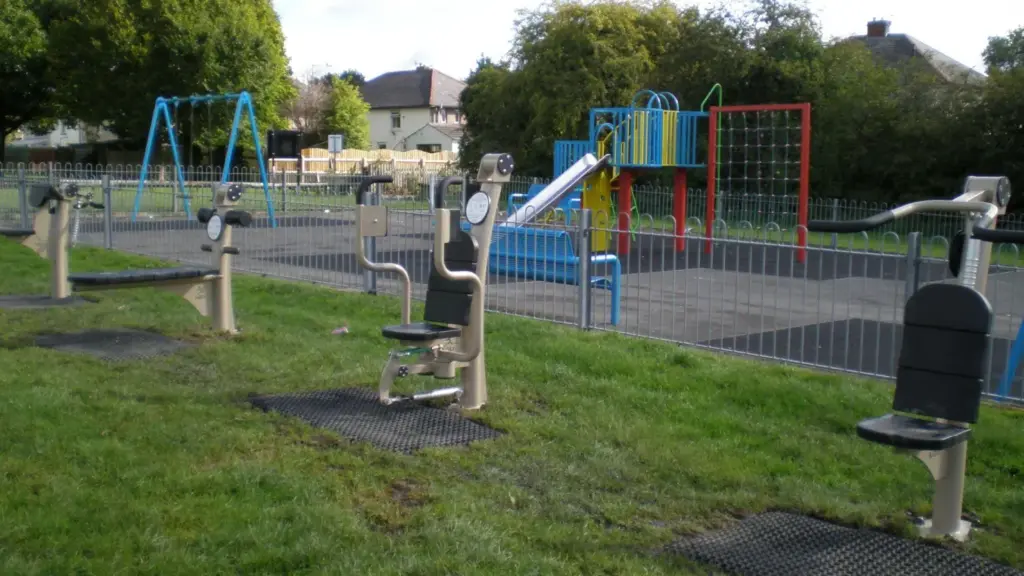
Play park and outdoor gym equipment refurbished with Big Local funds. Photo: Local Trust/ Bradley Big Local
Next steps for neighbourhood working
The future is communities. Across every sector — even in sessions focused on budgets and funding — my main takeaway from this year’s LGA conference is that lasting change is built alongside communities, through trust, relationships and sustained investment in people. At worst, this looks like co-production, at best, it is change led by the community itself. A thriving neighbourhood is not built by institutions acting alone, but through genuine partnerships that combine resident leadership with targeted investment.
To see what happens when communities lead on neighbourhood health improvement, watch three case study videos here.
Oluwatosin is Local Trust’s policy and communications assistant