Local Trust is a place-based funder supporting communities to achieve their ambitions.
Find out moreGo straight to…
< Back to main menuEssential guidance and information to help you deliver change in your community
Demonstrating the value of long term, flexible, resident-led funding
Find out moreA series of projects sharing what worked in the Big Local programme and why, and supporting the Big Local legacy in the communities that were involved.
The latest news and blogs from Local Trust, Big Local and beyond, exploring community power and resident-led change
ExploreGo straight to…
Local Trust is a place-based funder supporting communities to achieve their ambitions.
Find out moreGo straight to…
< Back to main menuEssential guidance and information to help you deliver change in your community
Demonstrating the value of long term, flexible, resident-led funding
Find out moreA series of projects sharing what worked in the Big Local programme and why, and supporting the Big Local legacy in the communities that were involved.
The latest news and blogs from Local Trust, Big Local and beyond, exploring community power and resident-led change
ExploreGo straight to…
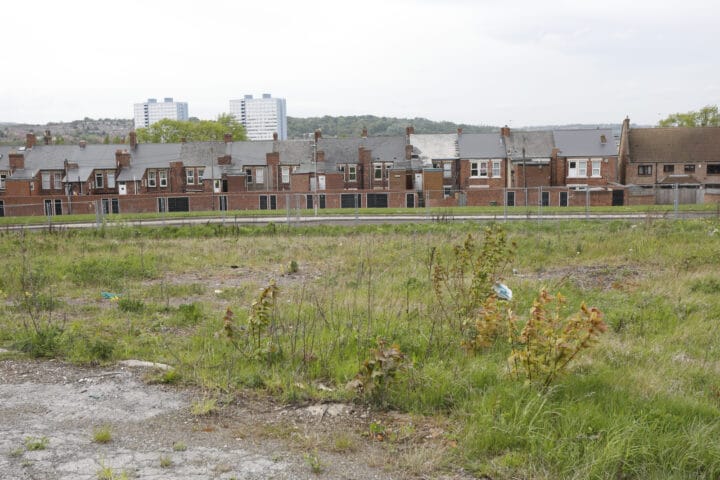
We define ‘left behind’ areas as places which face the double disadvantage of high deprivation and a lack of social infrastructure.
In 2018, we commissioned the Oxford Consultants for Social Inclusion (OCSI) to develop new data analysis to explore the difference that social infrastructure makes to outcomes in deprived communities.
Our experience of delivering the Big Local programme indicated that social infrastructure – defined as places and spaces to meet, connectivity (physical and digital) and community engagement – is a key determinant of the prospects of neighbourhoods and their residents.
This original, foundational, research identified 206 ‘left behind’ neighbourhoods across England. An update in 2020, to take account of changes to the Index of Multiple Deprivation, showed 225 wards falling into this category.
While our policy work increasingly refers to these areas as ‘doubly disadvantaged’, you’ll see both terms used interchangeably within our outputs and publications.
Combining data from two indices – the Index of Multiple Deprivation (IMD) and the Community Needs Index (CNI), which we partnered with OCSI to create – makes it possible to identify those neighbourhoods which face the double disadvantage of being severely deprived and having the least social infrastructure in the country.
These neighbourhoods are predominantly in post-industrial and coastal areas in the North and the Midlands. Their residents have markedly worse socio-economic outcomes than the residents of other equally deprived areas. This suggests the value and importance of social infrastructure.
Research has found that doubly disadvantaged neighbourhoods experience greater challenges across a range of life outcomes, including higher rates of poverty, lower educational attainment, and worse population health.
We have continued to collect data and improve the methodology for the research so we can better understand the social, economic and cultural dynamics of ‘left behind’ neighbourhoods to help develop responses which will enable them to prosper in the future.
This Index is the first of its kind; it maps community need at a hyper-local level in a way that has not been done before. As such it is a powerful tool for analysing and understanding spatial inequalities at the neighbourhood level, and enabling comparisons between neighbourhoods.
The wards that rank in the top 10 per cent most deprived on both the CNI and the Index of Multiple Deprivation are what we define as the most ‘left behind’ neighbourhoods in England. This analysis provided the first quantitative definition of what constitutes a ‘left behind’ area.
These communities suffer from the highest levels of combined economic and social deprivation – which is why we also refer to these areas as doubly disadvantaged neighbourhoods.
In 2022 we started to review and update the Community Needs Index, launching a consultation and engaging experts. The overarching aim was to refine the model, making use of the most up to date data and robust research approaches. The updated methodology which has now been published, will be used to provide further insights into the challenges and experiences of high needs communities.
We do not use ‘left behind’ to imply that the areas so described lack people with skills and commitment or a rich heritage. We know from our experience of the Big Local programme that the reverse is generally the case. However, such areas have tended not to receive their fair share of available investment and they therefore lack the services and facilities that many of us take for granted. It is these services and facilities that help to connect people in a community and bind them together, providing the opportunity for residents to develop and prosper. It is in this sense that they are ‘left behind’.
Local Trust was the secretariat of the All-Party Parliamentary Group for ‘left behind’ neighbourhoods, which was active between June 2020 and March 2024.
It was a cross party group of MPs and Members of the House of Lords, committed to improving social and economic outcomes for residents in communities that suffer from a combination of economic deprivation, poor connectivity, low levels of community engagement and a lack of community spaces and places.
Drawing upon our experience of delivering the Big Local programme, Local Trust’s research and policy advocacy have helped build the case for doubly disadvantaged neighbourhoods to be recognised and targeted for new funding by the government.
Ahead of our planned closure at the end of the year, discover Learning from Big Local – your resource for community-led change.