
What is Learning from Big Local and why does it matter?
Over the last 15 years, 150 communities across England have quietly been doing something radical: leading change themselves. Learning from Big Local exists to capture what Local Trust learned while supporting resident-led change, for the people shaping policy, funding and practice today. In this blog post, research manager, Chloe Juliette outlines how this resource can be used.
What is Big Local and why does it matter?
Big Local was a radical place-based funding programme giving 150 disadvantaged areas in England just over £1m each to spend over 10–15 years. What made it unique was its resident-led approach: communities, not funders, set priorities and made decisions.
The programme was delivered by Local Trust, created with an endowment in 2012 and due to close in 2027, with Big Local coming to an end in 2026. Big Local and Local Trust were funded by the National Lottery Community Fund.
There were no top-down targets or competition for funds. Instead, Big Local focused on helping communities identify their own priorities, build skills and confidence, and make lasting change on their own terms.
Over the years, residents that came forward to lead this work on behalf of their communities learned what was needed, delivered on it, and created a wealth of knowledge along the way. Big Local is closely associated with ideas of community development and community wealth building and demonstrates the importance of building social infrastructure when addressing long-standing disadvantage in an area.
What is Learning from Big Local?
In short, it’s a website, but an unusual one.
Learning from Big Local brings together years of research and lived experience from residents and those supporting them into one searchable learning space. It includes:
- 50 articles answering common questions about Big Local, synthesising research and staff reflections
- 150 summaries of what each of the Big Local areas did with their £1m over 10+ years
- 100 resident stories, so you can hear first-hand what it was like for those leading change on behalf of their communities
- 100 reports commissioned or delivered in-house throughout the programme, hand-picked to remain available and provide deeper insight.
With such a wealth of information available – totalling around 400 resources across the site –we’ve carefully designed a user experience that enables you to find what you’re looking for or mooch around with ease. You can browse the articles, stories, reports and area summaries by theme, including six topics that were most prevalent in what residents chose to focus on. These are:
- Community assets and spaces
- Health and wellbeing
- Investing in young people
- Responding to crisis and urgent need
- Local economy
- Place-based pride and connection.
A further three themes unpick how residents were able and supported to lead change in their area:
- Resident leadership
- Community engagement
- Working collaboratively.
A final theme – community change – brings together a few resources that discuss the overall learnings from the programme, the big picture thinking about community-led change.
Later this year, before Local Trust comes to its planned close having finished delivering the Big Local programme, we’ll also be adding some guidance, and a Theory of Change style page, summarising everything we’ve learned about the Big Local model – the necessary inputs to make resident-led change happen, the activities that took place that led to planned and un-planned outcomes, and the enablers/barriers to making those changes, along with key risks to watch out for in future community-led work.
Who is Learning from Big Local for, and how should they use it?
If you’re already sold on enabling residents to lead change on their own terms, this website helps you figure out how.″
While developing the material for the website, we had policymakers, funders, researchers and practitioners interested in doing resident-led change in mind. Local Trust’s policy team, alongside many other brilliant organisations, have worked to put disadvantaged neighbourhoods on the agenda and to help decision-makers understand that resident-led approaches are not only viable, but also cost-saving and highly beneficial to all involved compared to more top-down and traditional approaches to regeneration.
In short, it works. It’s not perfect, there are things to watch out for, and it won’t work every time – there were seven areas of 150 where the resident-led model was eventually disbanded, explored further in an upcoming article. But 143 is an impressive success rate. At Local Trust we believe in this model, and we know others do too.
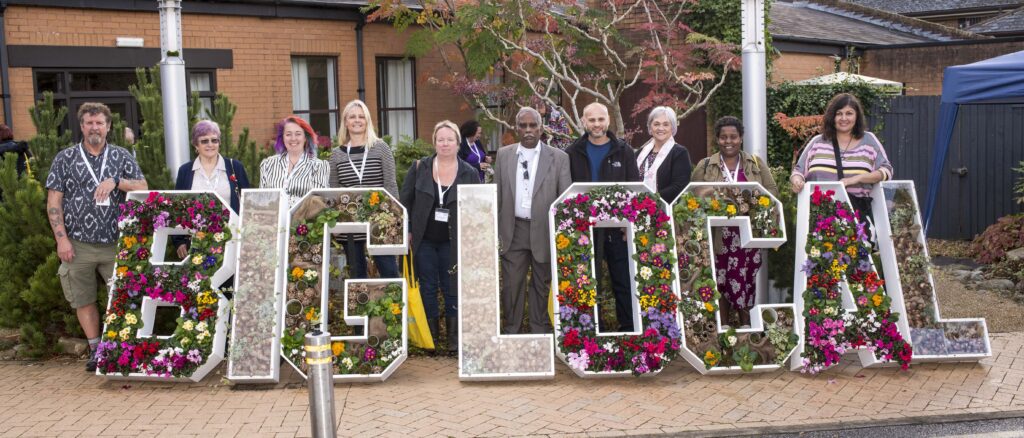
Big Local Connects 2021 Nottingham. Photo: Local Trust/Richard Richards
Learning from Big Local was not created to show people that they can and should enable more people to lead the decisions that impact their lives (though perhaps it will do that too). Learning from Big Local was created for the people who are on board and ready to do this work, re-shaping policymaking and grant-giving not just to ‘do with, not to’ people, but to empower people to change their lives and the lives of others in their communities.
That’s why I took on the challenging and enriching work of developing this site, really. I wanted to know what it looks like when regular people are given the resources and power to make change on their own terms. Alongside many other things, I’ve learned that they can really negotiate with local stakeholders from a position of strength that just can’t exist without that delegated say over how money is spent in their area.
Learning from Big Local is a resource for shaping future community-led change – it provides detailed accounts of how Big Local was designed, how it worked in practice, and learnings to inform future work. If you’re already sold on enabling residents to lead change on their own terms, this website helps you figure out how.
How you use the wealth of knowledge provided in these digital pages is down to you – where you are in your thinking or processes, and what’s most important to you or your organisation. The themes will help you find what you’re looking for, and for anyone unsure where to start – read the about page and have a look at the timeline to get a feel for the programme, then browse the Q&A articles by filtering the Resources page. This will give you the top-line intel. From there, follow your interests/ heart. I know a lot of people like to look at a few area summaries in their region too and find inspiration.
While this website is really designed for people wanting to do resident-led change, I’d encourage others with an adjacent interest to browse too. Personally, I came up through the world of co-production before getting into informing policy and practice through deliberative engagement/democracy and more traditional qualitative/mixed method research. When operating in these spaces, especially co-production, I always wondered what this ‘sharing of power’ would look like if service users and citizens had their own resources to bring to the table, balancing the uneven scales that are inevitable in these practices even if we do take our lanyards off, enable meetings between participants without the influence of those funding the work, and meet in a neutral place.
I’m not saying all co-production and deliberative work should allocate pots of money to those participating to do what they want with – though when we enabled that on the Care Experienced Young People’s Network, which I ran on behalf of Esmee Fairbairn a few years back, it worked incredibly well, so it’s worth exploring – but, there are certainly rich insights into how sharing power works and could be enhanced in a range of settings.
So, whether you design policy, fund programmes, research community development, or support residents directly, Learning from Big Local is here to help you empower people to make the changes they need.
Bookmark it. Explore it. Share it.
www.learningfrombiglocal.org.uk
Chloe is the research manager at Local Trust, managing the delivery of the Learning from Big Local project.