
Practical lessons on involving communities in place-based research
In February, Local Trust hosted an online seminar on the topic of community-led research. The latest in a series of seminars focusing on community development, this session brought together academic, community and third-sector researchers to reflect on their experiences of community involvement in research projects. In this blog, Local Trust’s senior researcher, Jack Loughnane, summarises some of the key learnings.
Not all researchers get place-based research right.
I’ve seen first-hand how easy it is to talk about ‘community involvement’ without creating the space and trust needed for meaningful community participation.
That’s why, in February, I was glad to be part of a research seminar hosted by Local Trust titled Community involvement in place-based research. We brought researchers together to have an honest conversation about what actually works – and what doesn’t – when involving communities in research.
If participation feels extractive, trust is eroded.
The seminar was chaired by Beth Perry, of the University of Sheffield, and the panel consisted of Leonie Taylor (Young Foundation), Chloe Juliette (Local Trust), and Sally Lloyd-Evans and Sonia Duval (University of Reading/Whitley Researchers). The presenters shared their experiences from their involvement in a wide range of research projects that placed community members at the centre of the work.
Following presentations by each of the speakers and a rich Q&A session, three clear lessons emerged – if we want research to genuinely support thriving communities, we must cast a wide net, show flexibility as researchers, and prioritise the experience of community members over narrow outcome measures.
1. Cast a wide net
Each of the speakers stressed the importance of reaching beyond the “usual suspects”.
Too often, research engages those already confident in institutional spaces, such as board members, forum regulars or those comfortable with formal consultation processes.
Casting a wide net is not just about fairness – it can lead to better decisions.
Leonie Taylor from the Young Foundation described how peer researchers were recruited using a sampling framework to identify gaps in who typically engages. The recruited peer researchers worked with the Young Foundation to design a community listening survey. They connected with residents and obtained over 300 survey responses in just two weeks, including from residents who might not have engaged through traditional channels.
Similarly, Chloe Juliette, research manager at Local Trust and lead on the development of the Learning from Big Local website, emphasised the need to ‘dig deeper’ and speak to many people to reach saturation and avoid elevating a few voices as the whole truth. One way to achieve this is to speak to people who work directly with residents and can help them tell their stories.
Casting a wide net is not just about fairness – it can lead to better decisions. For the University of Reading and Whitley researchers, assumptions about residents wanting retail and restaurants were challenged when community researchers surfaced more immediate concerns about safety and housing conditions. Listening widely reshaped priorities.
2. Show flexibility in how research is done
Presenters also discussed how flexibility was required, not only in relation to methodology, but also in terms of time, format, and communication. Not all community members will want to – or be able to – contribute in the same way.
At Local Trust, researchers travel to residents, adapt fieldwork formats, and keep reporting light-touch to minimise burden. Participation is voluntary and shaped around what works for local people. Some want deep involvement, while others prefer to contribute views at events or simply stay informed.
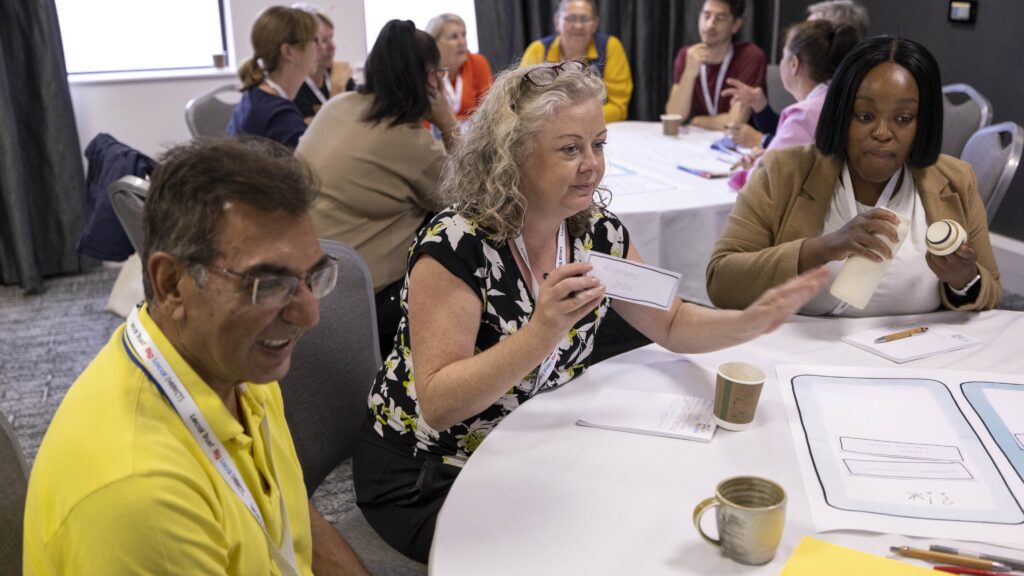
Groups talking and sharing experiences during Big Local Connects 2022. Photo: Local Trust/Richard Richards
Sally Lloyd-Evans and Sonia Duval demonstrated how participatory action research can incorporate creative methods, from Lego builds with young people to large-scale household surveys. Training and support are tailored to the scale of the project and the time residents can commit. Flexibility also applies to communication: not everyone checks emails daily, so researchers must meet people in spaces they trust and use.
When community members feel valued, they become ambassadors for change.
3. Prioritise expertise over outcomes
Finally, research should prioritise the experience of those involved. Outcomes matter, particularly when funding requires accountability. But if participation feels extractive, trust is eroded.
Across the seminar, speakers emphasised care, integrity, and transparency. This includes being clear about what participants can influence, paying community researchers properly, closing the feedback loop, and creating space for reflection and celebration.
In the Big Local context, residents valued opportunities to reflect on their progress as much as producing formal reports. In Whitley, community researchers described how involvement built confidence, skills, and pride. These are not ‘soft’ impacts – they are transformative.
When community members feel valued, they become ambassadors for change. Research moves from a one-off exercise to a regenerative infrastructure of participation.
To sum up
These three lessons challenge traditional research practices and remind us that place-based research is not just about generating knowledge, but about shifting power, building trust, and supporting democratic renewal.
You can watch a recording of the seminar here:
And if you’d like to hear about our next research seminar, please send us an email at research@localtrust.org.uk
For more on good practices in community-led research, read this article that shares lessons from community-led research on ethics, power and change.
Jack is the senior researcher at Local Trust, leading on a range of projects including the Partnership Reviews and Partnership Member Surveys.