
Health, wellbeing and belonging: Lessons from Big Local communities
As Big Local comes to an end in 2026, we’re reflecting on the ways communities have addressed local health and wellbeing challenges. In this blog, Lucy Thurley explores how shared meals and inclusive gatherings in Big Local areas like Wick Award and Pimlico Million have tackled loneliness and social isolation, by creating community spaces where people feel welcome, visible and valued.
Over the last 15 years, Big Local communities have shown that some of the most powerful health and wellbeing work happens in everyday spaces – over cups of tea, shared lunches, and regular moments of connection.
As Sharon a partnership member at Wick Award Big Local puts it:
“Just do it. I’m not saying it’s not hard work, but you get so much back, and you make people very happy.”
Loneliness and social isolation are no longer fringe issues. They are now recognised as major drivers of poor health and wellbeing, with real consequences for how long and how well people live.
Across Big Local communities, residents have responded to this challenge not with clinical interventions, but with something far simpler and more human: shared spaces, shared time, and shared experiences.
From community lunches to inclusive coffee mornings, Big Local areas have invested in places where people can connect, belong and support one another.
In this article, I reflect on two examples that show how everyday social connection can become a powerful foundation for health and wellbeing.
Not having people around you in an increasingly fractured world can be life-limiting. Loneliness and social isolation are now understood to be sources of chronic stress, with clear links to poorer health outcomes and increased mortality.
The World Health Organisation estimates that loneliness is connected to 100 deaths every hour worldwide. These risks are often compounded by wider structural inequalities, including economic insecurity and racial/gender based marginalisation.
Learning from lunch: how shared meals support health and wellbeing in Wick Award Big Local
For some people, this weekly lunch wasn’t just a nice social activity. It was the one thing in the week that helped them feel connected to others.
Eating together has been linked to improved heath, particularly for older people. In Hackney Wick, a rapidly changing area close to the Olympic Park in East London, Wick Award Big Local has recognised the power of bringing people together over a meal. Since 2014, they have been hosting lunches for local people. These are open invitations to join, share and be with friends and neighbours.
People eating together at Christmas at Wick Award Big Local. Photo: Wick Award
Wick Award commissioned a study to review older people’s needs in their area. While not all older people feel the need for social support, the study found evidence that confidence in being out alone, income and mobility decreased with age, making older people vulnerable to loneliness and isolation. A participant in the study called this experience ‘a deepening hole’.
Sharon, who we met above, established a weekly community meal on her estate in 2019 and has not looked back. She says, “Eating lunch together is a great way of bringing people together. People feel welcome.”
Reflecting on the lifeline that this offers, Sharon tells me about a regular who has sadly passed away. Their calendar was marked every Wednesday for lunch club: “lunch with us was the only activity in his week and it meant the world to him”.
Tackling isolation through inclusion – Pimlico Million Big Local
In central London close to the river Thames, Pimlico Million Big Local positioned themselves as enablers. With many community groups, organisations and charities active in their area, they convened spaces for collaboration by bringing groups together.
This does the work of what Cormac Russell has called an association of associations: developing the existing infrastructure by connecting groups and building relationships between them.

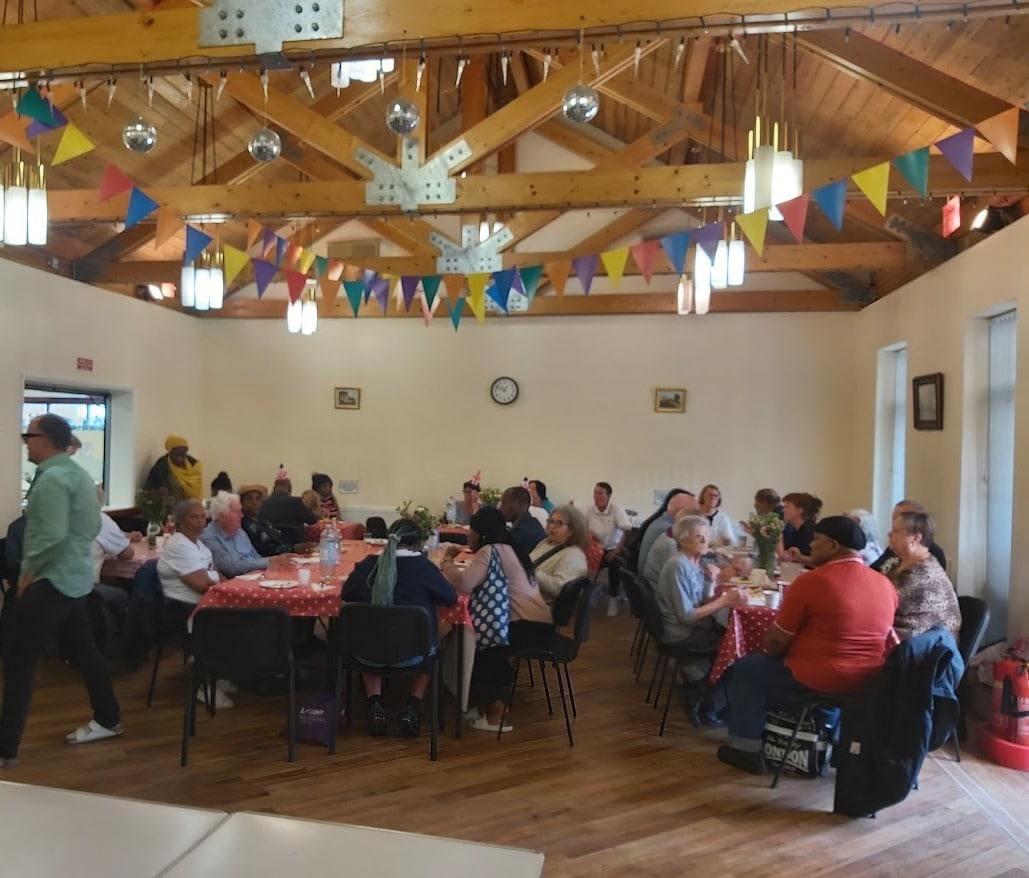
Community space within the Pimlico Million Big Local area. Photo: Local Trust
A key element of Pimlico Million’s relationship building work centred on a local community hall. The hall was underused and, most noticeably, not used at all by Global Majority communities. Pimlico Million worked with the leaseholders, slowly developing trust with the intention of increasing use of the hall.
They directly addressed the lack of inclusivity by hosting social occasions for Arabic-speaking women. The monthly bilingual coffee mornings give women the space to meet and connect, to feel belonging and joy in community space.
As time’s gone on, the coffee morning has grown and it has become multilingual. Linkages into and across faith, cultures and traditions have formed, bringing a potentially socially isolated group of women into contact with neighbours from all kinds of different backgrounds. As a bonus, women were able to take part in learning sessions put on by Pimlico Million.
By meeting in a shared community space, connection developed between people and with place. Working collaboratively, Pimlico Million broached the uncomfortable issue of ‘feeling welcome’, enabled social connection and opened the hall to use by a diverse range of communities.
Pimlico Million took an ethical position. One that was right for their community, had the courage and conviction to tackle exclusion head-on and in so doing materially improved the social lives of local people.
This work shows how health and wellbeing are shaped not just by services, but by whether people feel welcome, visible and valued in shared community spaces.
Everyday participation
The importance of these projects to local communities is evident in the care with which they are set up and maintained by both organisers and participants. It becomes a part of the life of the community. The connections that flow out from participation, from being together, reach further than just the membership of the group. They connect people to place.
I see this activity as being like a bouncing pinball that oscillates around, connecting people, places and movements, all whilst developing a life of its own. This sits right at the heart of sustainable practice: it’s not about an organiser/participant binary, or this person has power over that person.
It is people working, living and finding joy together, finding the patterns of communing that can be weaved amongst shopping, caring, employment or resting. The everydayness of the participation is what makes it work.
I’ll leave the final words to Sharon: “I love to see people coming back week after week. We have a great team, no-one gets paid, we do it because we want to and it makes us happy too.”
Thank you to Sharon and Polly for their help with this art, and to everyone at Wick Award and Pimlico Million Big Locals.
Lucy Thurley is the senior programme coordinator at Local Trust. She coordinates support for Big Local partnerships in London and the South East region.